Nepal Tourism: Unlocking the Potential of the Himalayan Nation

A complete look at what Nepal has, what needs to change, and what every Nepali can do to make it happen.
Nepal is a country that needs no introduction to the world of natural beauty. Home to eight of the world's fourteen highest peaks, ancient cities older than most nations, dense jungles sheltering tigers and rhinos, and a cultural tapestry woven from over 125 ethnic groups — Nepal is, by any measure, one of the most remarkable destinations on earth. And yet, it remains dramatically underutilised as a global tourism destination.
This blog explores the full picture: the immense potential Nepal holds, what the government must do to unlock it, how the country should promote itself to the world, and — critically — what local people can do to make tourism work for their communities.
The Current Reality: Promise vs. Performance
Tourism contributes roughly 6–8% of Nepal's GDP and is one of the top sources of foreign exchange. Pre-pandemic, Nepal was receiving around 1.1 to 1.2 million international visitors annually. Post-pandemic recovery has been encouraging, with trekking permits and Everest-region visits rebounding strongly.
But consider the contrast. Thailand receives over 30 million tourists a year. Vietnam crossed 12 million before the pandemic. Even landlocked Bhutan, with a strict "high value, low volume" philosophy, manages to extract far greater economic value per visitor than Nepal does. Nepal has arguably more to offer than many of these countries. The gap is not about resources — it is about strategy, infrastructure, and execution.
What Nepal Has to Offer: A Reminder
Before talking about solutions, it helps to appreciate the full range of Nepal's tourism assets, because most of the world only knows Everest.
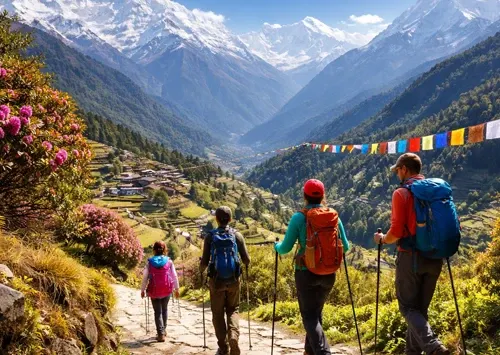
Nepal offers world-class mountain trekking, from the Annapurna Circuit to the remote Dolpo region. It offers wildlife experiences in Chitwan and Bardia that rival East African safaris for raw, unfiltered encounters. It offers Lumbini — the birthplace of the Buddha — one of the most spiritually significant sites on the planet. It offers the living heritage of the Kathmandu Valley, where seven UNESCO World Heritage Sites sit within a few kilometres of each other. It offers white-water rafting, paragliding over Pokhara, bungee jumping near the Tibetan border, and mountain biking trails that wind through terraced hillside villages.
And above all, it offers its people — generous, curious, resilient, and deeply proud of their homeland.
The problem is not what Nepal has. The problem is that the world does not fully know it, and when visitors do arrive, the experience is too often undermined by avoidable infrastructure failures and bureaucratic friction.
What the Government Must Do
The government holds the single most powerful lever in Nepal's tourism future. Policy decisions made — or not made — in Kathmandu ripple all the way to a tea house in Manang or a guesthouse in Bandipur. Here is what urgently needs to happen.
Invest seriously in infrastructure.
Unpaved roads, power outages, and poor internet connectivity in tourist zones are not minor inconveniences — they are deal-breakers for a growing segment of international travellers who expect a minimum standard of comfort even in remote settings. Tourism corridors, particularly in the Everest, Annapurna, and Langtang regions, need sustained infrastructure investment as a national economic priority.
Air access is equally critical. Tribhuvan International Airport in Kathmandu is chronically over-capacity. Regional airports in Pokhara and Bharatpur need upgrades and better international connections. Distributing tourists beyond Kathmandu is both a tourism strategy and an equity strategy.
Simplify the permit and visa system.
Nepal's overlapping permit system — TIMS cards, trekking permits, national park fees, restricted area permits — is a genuine deterrent for independent travellers. A single integrated digital permit platform, usable from anywhere in the world before arrival, would reduce friction and project a modern, organised image. Similarly, expanding visa-on-arrival facilities and strengthening e-visa systems makes Nepal more accessible.
Establish a dedicated Tourism Revenue Fund.
A portion of all tourism-related income — park fees, permit revenues, hotel taxes — should be ring-fenced and reinvested directly into trail maintenance, heritage conservation, waste management, and community tourism programs. This must be managed transparently, with public reporting, to build trust among both communities and international visitors.
Enforce environmental standards.
Nepal's reputation has been damaged by images of waste-covered Everest trails, polluted rivers near trekking routes, and deforestation around popular campsites. Existing environmental regulations need to be enforced, not just written. Plastic bans in mountain regions must be real bans, with checkpoints and consequences. Waste management infrastructure — porter-carrying waste down trails, incinerators at key hubs — needs funding.
Develop off-season and off-route tourism.
Nepal's tourism is dangerously concentrated in two seasons (October-November and March-April) and two geographic zones (Everest and Annapurna). The western regions — Rara Lake, Dolpa, Humla — receive a fraction of the visitors they deserve. Government should actively incentivise travel to these areas through reduced permit fees, targeted marketing, and infrastructure investment. Monsoon trekking, winter wildlife safaris, and spring festival tourism all have strong potential that currently goes largely unpromoted.
Set and enforce quality standards.
Substandard accommodation, uncertified guides, poorly maintained equipment in adventure sports, and inconsistent food safety undermine Nepal's reputation. A tiered certification system for guesthouses, guides, and operators — with clear minimum standards and accessible pathways to certification for small operators — would raise the overall quality of the Nepal tourism experience.
How Nepal Should Promote Itself to the World
Nepal Tourism Board has run several national campaigns over the years, with mixed results. Strong on broad awareness, weaker on converting that awareness into diverse, high-spending visitors. The next generation of promotion needs to be smarter, more targeted, and more story-driven.
- Go digital, seriously.
A world-class official tourism website with real trip-planning functionality — detailed trekking route guides, interactive maps, permit information, accommodation listings, seasonal advice — would serve travellers far better than static brochure content. High-quality video campaigns on YouTube and Instagram, consistently maintained, outperform expensive print campaigns at a fraction of the cost.
- Work with content creators, not just ad agencies.
The modern traveller trusts an authentic travel vlogger or adventure photographer far more than government promotional material. NTB should run a formal international content creator program, providing logistical support and access in exchange for genuine, high-quality storytelling that reaches millions of potential visitors. This is not simply paying influencers — it is investing in authentic narrative.
- Diversify target markets.
India remains the largest source of visitors by volume, and that relationship is important. But there is enormous untapped potential in South Korea, Japan, Vietnam, Taiwan, and the Gulf states — markets with strong and growing middle classes who are actively seeking nature-rich, culturally deep destinations. China's full return to outbound travel also represents a major opportunity requiring relationship-building now.
- Pursue luxury and wellness tourism.
This segment is fast-growing globally and Nepal is positioned well to serve it. High-end eco-lodges in remote valleys, meditation and yoga retreats, Ayurvedic wellness programs, and curated cultural immersion experiences can generate far more revenue per visitor than budget backpacker tourism. A handful of thoughtfully developed luxury properties in Mustang or Upper Dolpa could change how the world sees Nepal.
- Use film and media strategically.
Nepal remains almost invisible in international cinema and television. A proactive film tourism policy — offering streamlined location permits, tax incentives, and production support — could bring international productions to Nepal's landscapes and transform global awareness in ways that advertising budgets simply cannot match. One acclaimed documentary or popular streaming series set in the Himalayas can reach audiences of tens of millions.
- Show up at global travel markets.
Nepal's presence at ITB Berlin, World Travel Market London, and Arabian Travel Market Dubai should be elevated from a small booth to a serious commercial engagement — with hosted buyer programs, media events, and genuine follow-up with international tour operators and travel agencies.
What Local People Must Do
This is perhaps the most important section of this blog, because no government campaign and no amount of foreign investment can substitute for what local communities do every single day in their interactions with visitors.
Keep your surroundings clean.
This sounds basic, but it is foundational. Travellers notice litter on trails, waste in rivers, and rubbish near heritage sites. Clean public spaces signal a community that takes pride in what it has. Trail clean-up drives, community composting, and refusing to use single-use plastic in tourist areas are acts of genuine tourism development.
Invest in language and hospitality skills. A warm greeting in broken English means more to a visitor than a polished presentation in a language they don't understand. Basic English language skills, combined with genuine hospitality — a smile, an offer of help, a story about local life — create the kind of memorable experience that turns a visitor into an ambassador who tells ten friends about Nepal.
Participate in community-based tourism. Homestays, village walking tours, cultural cooking experiences, local craft demonstrations — these are tourism products that communities can create and own. They keep tourism revenue within local economies, provide authentic experiences that large hotels cannot replicate, and give communities direct agency over how they engage with visitors. Programs like these have succeeded in the Annapurna region and the Terai and can be replicated across the country.
Protect your cultural heritage actively. Festivals should remain genuine celebrations, not performances put on for cameras. Temples and heritage sites should be maintained with community effort, not left to decay between government repair cycles. Traditional crafts — Thangka painting, Dhaka weaving, Newari woodcarving — need young people willing to learn them, because a living craft tradition is a tourism asset that no brochure can manufacture.
Support and demand fair practices. Overcharging tourists, providing misleading information, or treating visitors as targets rather than guests damages not just individual reputation but Nepal's reputation as a whole. Communities benefit when tourism is honest, fair, and genuinely hospitable. Equally, local people should advocate for fair wages for guides and porters, safe working conditions in the tourism sector, and equitable distribution of tourism income within communities.
Women and youth must lead.
Some of Nepal's most inspiring tourism innovations have come from women-led trekking companies, female mountain guides, and young Nepalis using social media to showcase their homeland to the world. These voices carry enormous credibility internationally and deserve full community support, not social barriers.
The Challenges That Need Honest Acknowledgement
Nepal's tourism potential is real, but so are the obstacles. Political instability has historically disrupted policy continuity — tourism boards change leadership, campaigns are abandoned, and long-term investors stay cautious. This needs to change. Stable, professional, long-term governance of the tourism sector is not optional.
Revenue leakage is also a serious concern. When tourists stay in foreign-owned hotels, fly on foreign airlines, eat imported food, and book through overseas tour operators, much of the money they spend never reaches Nepali communities. Policies that support locally owned businesses, locally produced food and crafts, and Nepali travel companies help ensure tourism income actually stays in Nepal.
Finally, climate change is not a distant threat — it is already reshaping Nepal's glaciers, altering trekking seasons, and increasing the frequency of extreme weather events. Tourism strategy must take this seriously, both in terms of sustainability practices and in terms of how Nepal presents its changing landscape to visitors.
The Road Ahead
Nepal does not need to reinvent itself. It needs to invest in what it already has — deeply, consistently, and with a long-term vision that outlasts election cycles.
The world is hungry for travel that means something. Travellers today are seeking depth over convenience, connection over consumption, and stories worth telling for years. Nepal offers all of this in abundance. The mountains have always been extraordinary. The culture has always been rich. The people have always been warm.
What Nepal needs now is the political will, the community commitment, and the strategic clarity to make sure the world finally gets to experience it properly — and that when they do, it benefits every Nepali, from the teahouse owner in a remote valley to the city guide in Kathmandu's teeming streets.
Nepal's tourism moment is not coming. It is here. The only question is whether Nepal is ready to seize it.
📅 Published: June 17, 2026 | ⏱️ 1 min read